Why it matters · History · Sharecropping
How did agriculture begin and how did it change the history of Italy?
November 2, 2026 · 3 min read
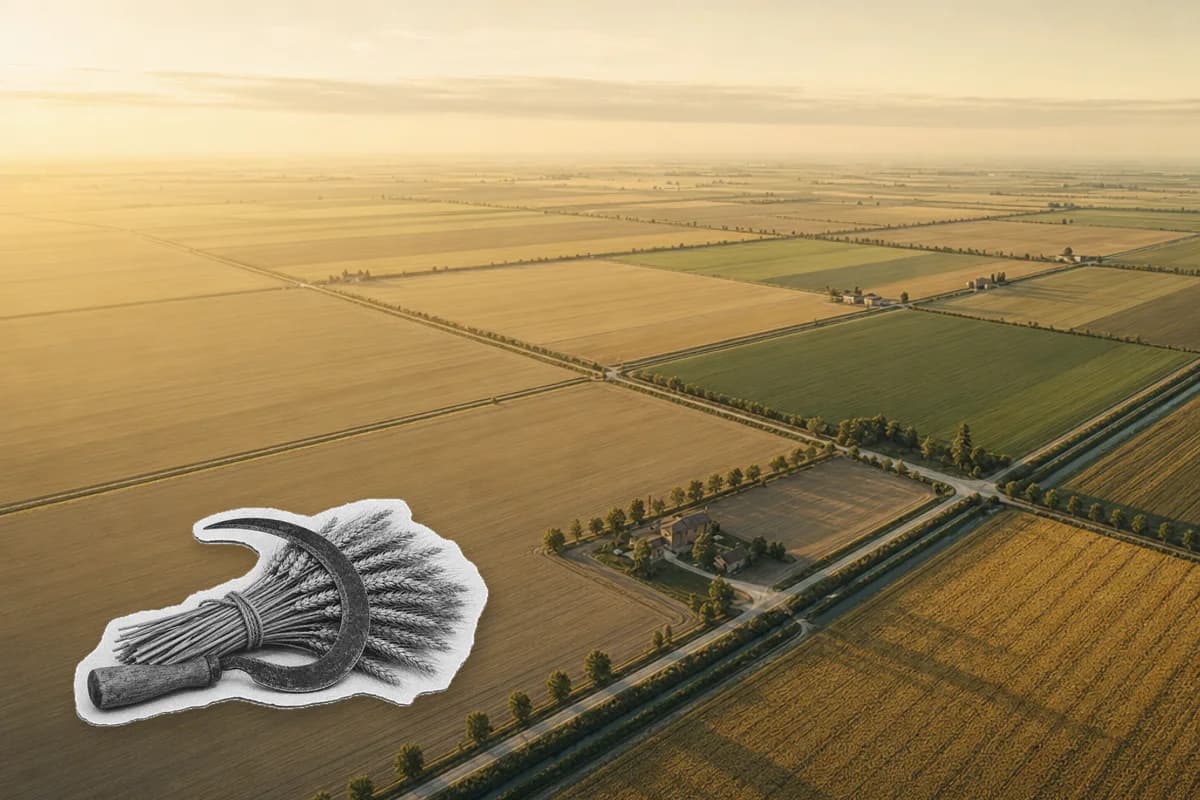
Agriculture was born in the Near East, where the first plants were probably cultivated about 10,500 years ago. From there came villages, cities, writing and the calendar. In Italy it shaped the landscape: 5.7 million people worked in the primary sector in 1961, today about 800,000 (ISTAT, Italy's national statistics institute, 2024).
1. From the first harvest to the first villages
According to Treccani (the Italian encyclopedia), the oldest documented cultivation of wheat and barley is at Jericho, in the phase between 10,000 and 8300 BC. The oldest remains of domesticated animals, from about 11,000 years ago, come from Zawi Chemi Shanidar, in Iraq.
People who farm stay in one place. In the Pre-Pottery Neolithic, communities in the Near East became highly settled, with large settlements and monumental buildings. Agriculture reached Europe about 8,500 years ago, brought by farmers migrating from Anatolia and the Aegean.
2. Cities, writing and the calendar
In Mesopotamia in the 4th millennium BC, fields irrigated with small canals gave up to two or three harvests a year. The first urbanisation began. Uruk covered about 70 hectares, growing to about 100 around 2900 BC. Temples and palaces paid for labour in barley: an adult man received about 60 litres a month, women and children about half.
Keeping accounts became necessary. According to the scholar Denise Schmandt-Besserat, cited by Treccani, the need to count came from planning the harvest. From about 8000 BC, clay tokens stood for products of the land and of livestock. At the end of the 4th millennium BC, tokens gave way to signs on tablets: this was writing. Among the first texts are those from the area of the Eanna temple, in Uruk.
The calendar also followed the fields. In ancient Egypt the three seasons matched the Nile flood, the retreat of the waters, when sowing took place, and the harvest. From this came a calendar of 365 days, tied to the flood and to the rising of Sirius.
3. The Romans and the Italian land
The Romans assigned land to settlers through centuriation (centuriazione), a grid of roads called decumani and cardines. Each square, the centuria, had a side of 20 actus and an area of 200 iugera (Roman units of length and area). The purpose was mainly military control, and secondly to settle population. Its marks remain in the plain of Capua, around Florence, in much of Emilia and in the Po Valley.
4. Sharecropping and the rural exodus
Sharecropping (mezzadria) was a contract common above all in central Italy. The owner granted the farm, the farming family lived on it and worked it, and produce and profits were split in half. Law no. 756 of 15 September 1964, in article 3, states that no new sharecropping contracts can be signed. Contracts signed against this ban are void.
After the war, ISTAT recalls, land reforms redistributed land to farmers. Then, between the 1960s and 1970s, mechanisation and fertilisers reduced rural labour in favour of industry. Workers in the primary sector went from 9.4 million in 1931 to 5.7 million in 1961. They were 1.6 million in 1991 and about 800,000 in 2024. Since 1861 their share of the working population has fallen from 70% to just over 3%.
People working in Italy's primary sector (farming, forestry and fishing)
- 19319.4 million
- 19615.7 million
- 19911.6 million
- 20240.8 million
5. And the land today
There were 4.2 million farms in 1930, and 1.1 million in 2023. Total farmland fell from 26.3 million hectares in 1930 to 15.9 million in 2023. In 2023 less than half of farms (48.8%) farmed only land they owned: in 2010 it was 73.3%.
Generations before us farmed this land. Is there an idle plot that someone could farm again?
Sources
- Treccani, voce "Neolitico", Enciclopedia
- Treccani Atlante, "Come nasce l'agricoltura in Europa"
- Treccani, "L'origine della città", in Storia della civiltà europea a cura di Umberto Eco
- Treccani, "Vicino oriente antico. L'origine della scrittura e del calcolo", in Storia della Scienza
- Treccani, "Sistema tecnico e osservazione della natura nell'antico Egitto", in Storia della civiltà europea a cura di Umberto Eco
- Treccani, "Centuriazione", Enciclopedia dell'Arte Antica
- Treccani, voce "Mezzadria", Enciclopedia
- Normattiva, Legge 15 settembre 1964, n. 756, Norme in materia di contratti agrari, art. 3
- ISTAT, I cambiamenti dell'agricoltura, 2026
- ISTAT, Struttura produttiva, pratiche gestionali e forza lavoro delle aziende agricole, anno 2023, 2026
Read next
Why it matters · Economy · Exports
Why agriculture matters: Italy's farm economy in numbers, 2025
In 2025 Italian agriculture produced €80.1 billion, and Italy is the first country in the European Union for agricultural value added. Adding the food industry, the supply chain is worth €89 billion, 4.4% of the whole economy of the country. And in the first eleven months of the year, Italian food sold abroad for almost €67 billion, 5% more than in 2024.
Land · Farm Leases · Law 203/82
Farm leases in derogation in Italy: how they work and how they differ from the 15-year rule
A farm lease "in derogation" (affitto agrario in deroga) is a contract where the owner and the tenant agree on rules different from those of the law on agricultural contracts. It is valid only if signed with the assistance of the professional farmers' organisations. The standard rule is a minimum length of 15 years.