Around the world · Farm Machinery · Agriculture 4.0
Precision agriculture in Italy: where does it stand and what skills do farm machines require?
November 2, 2026 · 3 min read
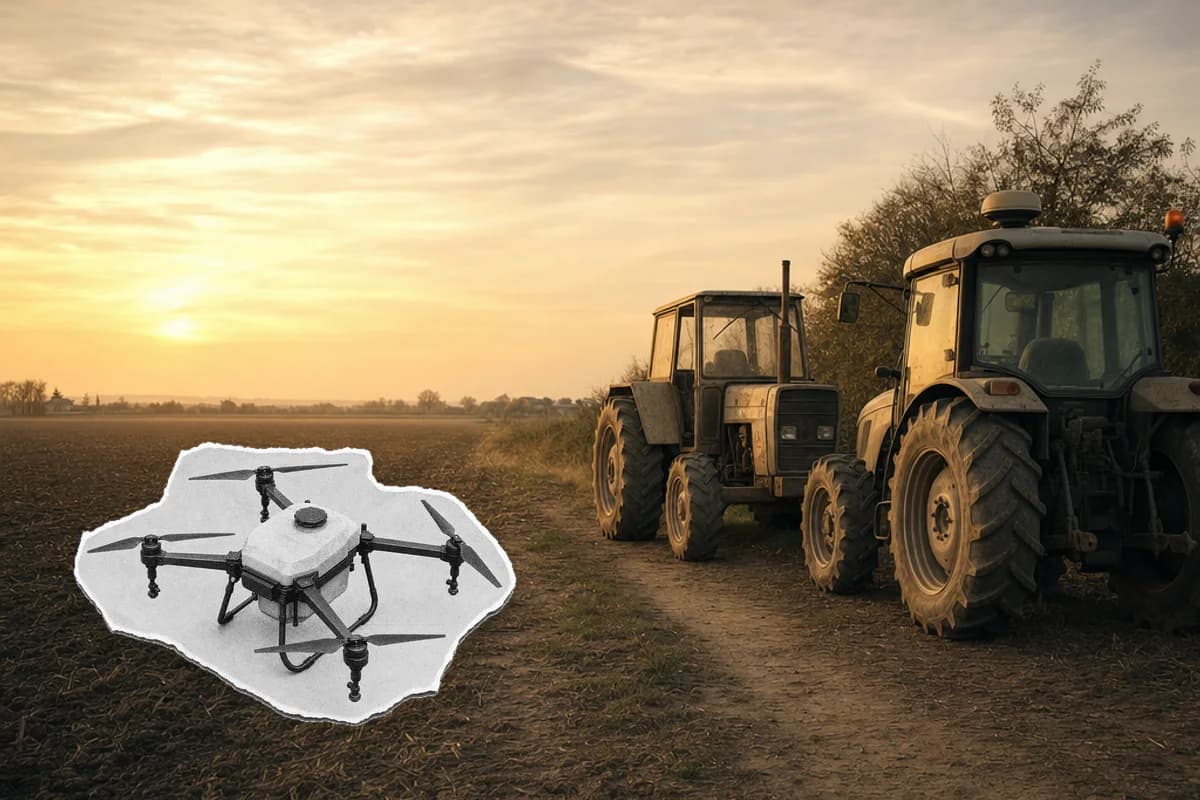
In Italy the agriculture 4.0 market was worth €2.5 billion in 2025, up 9% on 2024. 42% of farms use at least one digital solution. Yet land farmed with digital technologies is only 10% of the total. According to FAO, machines do not make work disappear: they shift it toward more skilled jobs.
1. Where Italy stands
The Smart AgriFood Observatory of Politecnico di Milano and the University of Brescia measures agriculture 4.0: connected machines, sensors and farm management software. After falling 8% in 2024, the market returned to its 2023 record level in 2025. Software grew the most: decision support systems rose +26%, farm management systems +17%. Connected machines rose +2%.
The gap is still wide. Only 9% of farms are digitally mature, 33% are on their way and 58% are lagging behind. Only 21% would invest without public incentives.
ISTAT (Italy's national statistics institute) uses a different measure. In 2023, 73.3% of farms used at least one machine. 18.5% used computers or other digital equipment, for example for bookkeeping: in 2010 it was 3.8%. In the South the share is 6.7%, in the North-East 42.4%.
Agriculture 4.0 in Italy: growing, but still a minority
€2.5 bn
agriculture 4.0 market in 2025, +9% on 2024
42%
farms with at least one digital solution
10%
farmland cultivated with digital technologies
58%
farms lagging behind in digital maturity
2. Europe and the world
According to Eurostat, in 2023 just under 18% of European farms applied some precision technique. However, those farms manage about 44% of farmland. Robots, meaning machines that work without direct human control, are found on about 7% of farms.
The gap by farm size is large. Among farms with at least €100,000 of standard output, a measure of economic size, about 31% use robots. Below €2,000 it is about 1%. For FAO (2022) the gap is wide between countries and within countries. The first autonomous robots for harvesting, sowing and weeding have started to go on sale.
3. Few machines are being renewed
In 2025, 17,573 tractors were registered in Italy, 13.7% more than in 2024. In 2024, with 15,450, registrations hit a record low. FederUnacoma, the Italian federation of farm machinery manufacturers, credits the recovery mainly to public incentives. In the first nine months of 2026 tractor registrations were 12,290, 3.3% fewer than the year before.
The used market weighs heavily. In 2025 farmers bought more than 60,000 used tractors, against 25,000 in 2014. According to FederUnacoma these are very old machines, with an average age of over 22 years. What holds back new purchases, it says, is low farm profitability.
4. How work is changing
According to FAO, automation reduces repetitive work, such as sowing and harvesting, and increases skilled work. The fear of rising unemployment is understandable, but history generally does not support it. ISTAT links mechanisation to the fact that farm employment today is less than a tenth of what it was in the early 1930s.
Who does the work is changing too. From 2010 to 2023, family workers fell by 75.3%, while non-family workers grew by 10.8%.
Many farms also do not buy machines. In Italy, 26.7% of farms used no machinery: they are livestock-only farms or farms that use contract services (contoterzismo), that is, services from other farms or specialised companies. In Europe, 21% of farms only rent or share machines, and 27% combine their own machines with other people's. FAO points to rental services as a route for those who cannot buy. The Observatory names the shortage of specialist skills as a structural barrier.
Can you drive and manage the latest farm machines, or are you looking for someone who can do it for your farm?
Sources
- Osservatori Digital Innovation, Politecnico di Milano e Università di Brescia, comunicato "Torna a crescere il mercato dell'Agricoltura 4.0: 2,5 miliardi di euro (+9%)", 2026
- ISTAT, Struttura produttiva, pratiche gestionali e forza lavoro delle aziende agricole, anno 2023, 2026
- ISTAT, I cambiamenti dell'agricoltura, 2026
- Eurostat, Agriculture statistics: machinery and digitalisation, 2026
- FAO, The State of Food and Agriculture 2022: Leveraging automation in agriculture for transforming agrifood systems, riassunto esecutivo, 2022
- FAO, comunicato sul rapporto SOFA 2022, 2022
- FederUnacoma, Macchine agricole, mercato in ripresa nel 2025, 2026
- FederUnacoma, Macchine agricole: mercato Italia in ripresa, ma frenano le esportazioni, 2026
- FederUnacoma, Presentazione EIMA 2026 al Masaf, 2026
Read next
Around the world · Forecasts · OECD-FAO
How will agriculture change in the next ten years? The OECD-FAO outlook to 2035
According to the OECD and FAO, the value of world agricultural output will grow by 13.3% in ten years. It will reach 4,010 billion dollars in 2035, at constant prices. Real prices will stay stable or fall below today's level. Output will grow mainly through yields: 73% of the increase in crops. Direct emissions from agriculture will rise by 6.5%. These are the figures of the 2026-2035 report, published on 29 June 2026.
Land · Farm Leases · Law 203/82
Farm leases in derogation in Italy: how they work and how they differ from the 15-year rule
A farm lease "in derogation" (affitto agrario in deroga) is a contract where the owner and the tenant agree on rules different from those of the law on agricultural contracts. It is valid only if signed with the assistance of the professional farmers' organisations. The standard rule is a minimum length of 15 years.